Pawn Rules in Chess: Moves, Captures, En Passant and Promotion
The pawn is the weakest piece in chess, but it has the most rules: a two-square first move, diagonal captures, en passant and promotion. Each player starts with eight pawns. Here is every pawn rule, with diagrams and examples.
How a Pawn Moves
- One square straight forward, toward the far side of the board.
- Two squares forward on its first move only, if both squares are empty. White pawns start on rank 2, Black pawns on rank 7.
- Never backward and never sideways.
- A pawn can't jump. If any piece stands directly in front of it, the pawn is blocked.
How a Pawn Captures
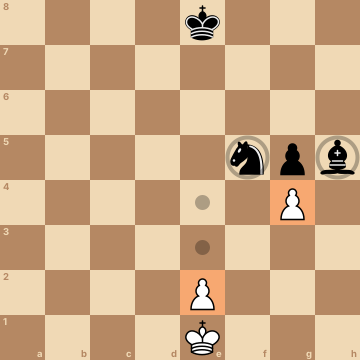
A pawn captures one square diagonally forward, never straight ahead. A white pawn on e4 can capture a piece on d5 or f5, but a piece on e5 simply blocks it. The pawn is the only piece that moves one way and captures another.
The En Passant Rule, Explained
En passant (French for "in passing") lets a pawn capture an enemy pawn that has just moved two squares and landed beside it. You capture it as if it had moved only one square. All four of these must be true:
- Your pawn has reached rank 5 (for White) or rank 4 (for Black).
- An enemy pawn on a file next to yours moves two squares forward from its starting square.
- It lands right beside your pawn.
- You capture on your very next move. Wait one move and the chance is gone.
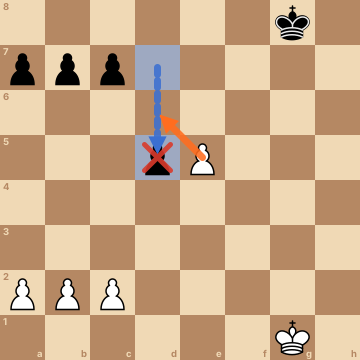
Example: White has a pawn on e5. Black plays d7 to d5, landing beside it. White can capture e5 to d6: the white pawn moves to d6 and the black pawn on d5 is removed. It is written exd6 e.p.
En passant is optional. You only have to play it if it is your only legal move.
Pawn Promotion
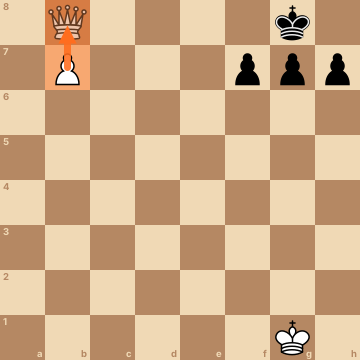
When a pawn reaches the last rank (rank 8 for White, rank 1 for Black), it must be promoted. You swap it for a queen, rook, bishop or knight of your color, as part of the same move.
- You can't keep it as a pawn, and you can't make a king.
- You can choose a piece you still have, so two or more queens is allowed.
- A queen is usually best. Choosing another piece is called underpromotion: a knight can give a check or fork a queen can't, and a rook or bishop can avoid stalemating your opponent.
- In casual games, players often use an upside-down rook as a second queen. In tournaments that counts as a rook, so stop the clock and ask the arbiter for a queen.
Common Pawn Mistakes
- Capturing straight ahead. Pawns only capture diagonally.
- Moving two squares after the first move. The double step is only for a pawn that hasn't moved yet.
- Forgetting that en passant expires. It is only allowed on the very next move.
- Thinking a pawn can only promote to a captured piece. You can choose any of the four pieces.
Practice Pawn Rules on a Free Board
On Chess Pass and Play, tap a pawn and the move hints show every legal square, including an en passant capture when it is available. When a pawn reaches the last rank, a Choose Promotion box lets you pick a queen, rook, bishop or knight.
Play it with a friend on one device, free and offline. Then learn castling, the other special move.
Pawn Rules FAQ
No. Pawns only move forward, toward the far side of the board.
No. Only on its first move, and only if both squares in front of it are empty.
No, it is optional. You only have to play it when it is your only legal move.
No. A pawn can become a queen, rook, bishop or knight, but never a king.
Yes. Promote a pawn while your first queen is still on the board and you have two.
No. A pawn captures one square diagonally forward. A piece straight in front of it blocks it.
More Chess Guides
Practice Pawn Rules With a Friend
Two players, one device, no sign-up. Move hints show every legal pawn move.